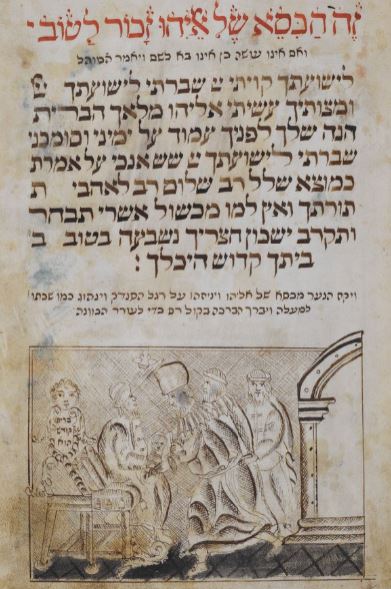
An infant enters the covenant of Abraham surrounded by people who each have a part to play. This illustrated manuscript gathers prayers for circumcision, copied on parchment in 1817 by Mordecai ben Josel Sofer of Nitra. Its title page places Aaron, in priestly dress, opposite Moses holding the tablets. Their figures frame a book made for Lipman ben Saul Ehrenfeld, whose name also appears on its leather binding.
The circumcision scene shown below brings the ceremony into a more familiar setting. The seated sandek holds the infant on his lap while the mohel, the ritual circumciser, bends over the child. A woman, perhaps the child’s mother, stands behind the sandek, with the words “It is a sacred covenant” written over her heart. Two men stand nearby as attendants or witnesses; one may be the father, but the illustration does not identify them. At the left stands a separate chair reserved for Elijah. The people present welcome the boy into the community; the empty chair gives that welcome a place in the larger story of Israel.
Elijah’s presence draws on his identification as the “messenger of the covenant,” a phrase from Malachi. An early medieval midrash requires a seat of honor for him at every circumcision. As the herald of the Messiah, Elijah connects the covenant renewed in one child’s body with the hope of redemption for the whole people. The prayer above the illustration addresses him directly and asks him to stand beside the circumciser.
The ceremony’s human roles also carry a history of encounters with Christian neighbors. As historian Ivan Marcus explains, the sandek resembles the sponsor at baptism; the Greek term behind his title also served Christians for a godfather. Medieval Ashkenazic Jews later added male and female ceremonial sponsors, known as kvatter and kvatterin, who helped bring the child to the ceremony. Their participation echoed Christian godparenthood and widened the circle of people honored at a birth.