At first glance, this sheet resembles a shiviti, a plaque intended to focus attention on God during prayer. Such plaques commonly display the divine name above a menorah whose seven branches contain the seven verses of Psalm 67, excluding its introductory heading. Many also incorporate angelic names and formulas intended to protect the household.
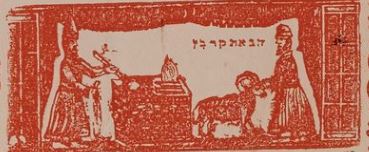
Zalman Segalovitsh of Vilna puts this familiar design to an unusual purpose. Printed in Warsaw in 1886, his Zikhron ha-Menorah—here understood as “The Menorah Explained”—places the Torah’s account of lighting and making the menorah, Numbers 8:1–4, within its branches. The title occupies the crown above it. Numbered explanatory panels surround the lampstand, guiding readers through calculations that connect the biblical words with the menorah’s parts. Small illustrations show people tending the lamps and handling sanctuary vessels.
The central image has the character of a technical drawing. Its branches repeat the same angles, and its parts remain visible without receding toward a vanishing point. Maintaining their proportions on a flat surface produces the branches’ distinctive waves and bends. Readers can inspect the menorah’s construction while following the biblical words distributed across it. The surrounding explanations extend that visual lesson into an exposition of the text.
The sheet retains prayers and sacred names, but its explanations give it the character of an educational chart. One panel compares the menorah to a palm tree and the Tree of Life. Another draws an ethical lesson from its manufacture: the requirement to fashion the menorah from a single piece of gold becomes an image of human unity, culminating in “Love your neighbor as yourself.” The devotional form provides a framework for studying scripture and finding a rationalist moral meaning in its details.
Red printing distinguishes the menorah, illustrations, and ornamental borders from the black explanatory text. Below the Hebrew text, a Russian censorship notice records permission to print on October 22, 1886. The broadside belonged to the collector Elkan Nathan Adler.