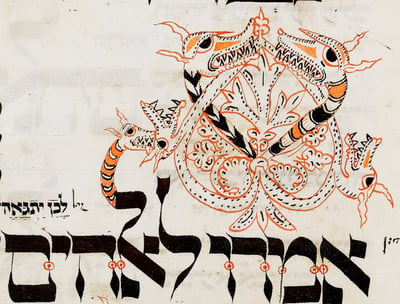
Esslingen Mahzor 93v
Esslingen Mahzor 93v
The word “Mahzor,” means “cycle" and is familiar to most Jews as the term used for the prayer book for the High Holidays and festivals. However, in medieval times, the term Mahzor was used to refer to prayer books that contained the complete cycle of prayers for the entire year.
Copied in Esslingen, Germany, in 1290 by the scribe Kalonimos ben Yehudah, this mahzor contains prayers for Rosh Hashanah, Yom Kippur, and Sukkot. It is the earliest dated Hebrew book from Germany. The manuscript is large, with pages measuring 18 x 14 inches. Its size tells us that it was designed for synagogue use by the prayer leader, likely placed on a stand at the center of the prayer hall as the prayers were intoned for the entire congregation.
Originally one volume, it was later split in two. The first half, covering Rosh Hashanah through the morning of Yom Kippur, is in the collection of the JTS Library. The second half, from the additional service on Yom Kippur through Sukkot, Shemini Atzeret, and Simchat Torah, is in Amsterdam (Rosenthaliana MS 609).
This page includes a piyyut (liturgical poem) for the High Holidays. But you will also immediately notice the dragons that adorn the page. Images of dragons are found throughout this manuscript, having nothing to do with the text but very popular, among Christians and Jews, in medieval Germany and elsewhere.