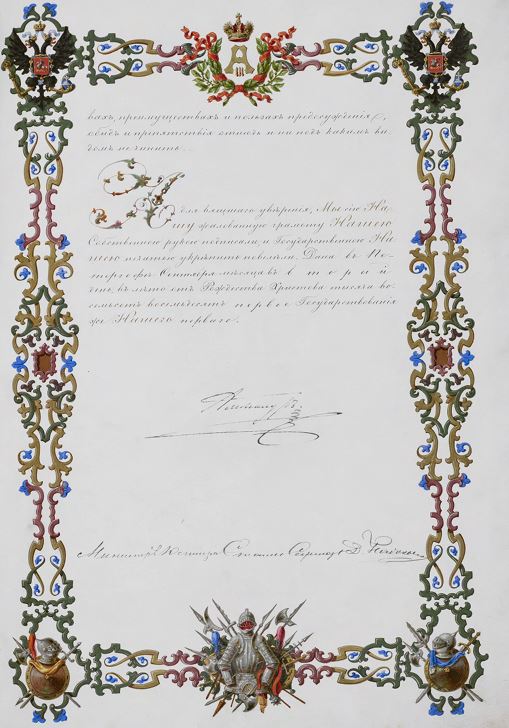
A crowned double-headed eagle presides over this charter’s opening page. Small coats of arms fill the winding border, surrounding the elaborate Russian lettering with a picture of imperial dominion. At the center stands the name Alexander III, followed by his titles as emperor and autocrat. Before the document reaches the person it honors, it establishes the authority of the ruler who grants that honor.
The charter records the ennoblement of Dr. David Rosenthal, a Jewish physician who spent much of his career at the Jewish Hospital in Warsaw. It dates to 1881 and is signed at the end by Czar Alexander III (see below). Its four illuminated leaves measure forty-five by thirty-two centimeters (approximately seventeen and a half by twelve and a half inches—about the size of a large serving tray). The document survives with a fragile wax seal housed in a bronze canister and with its original protective box.
Rosenthal (1808–1889) studied medicine in Vienna and received his doctorate in 1834. He joined the Jewish Hospital in Warsaw in 1836 and later served for decades as its chief physician, retiring from that post in 1879. He treated patients during cholera epidemics and taught hygiene at the agricultural and forestry institute in Marymont, near Warsaw. His career combined care within a Jewish communal institution with work in the wider medical world.
Ennoblement placed such professional achievement within the empire’s hierarchy of rank and status. Nobility carried legal distinctions as well as social prestige. A charter provided lasting documentary evidence of the recipient’s recognized standing. Its formal language and authentication allowed imperial authority to operate beyond the ruler’s presence, wherever the document’s standing needed recognition.
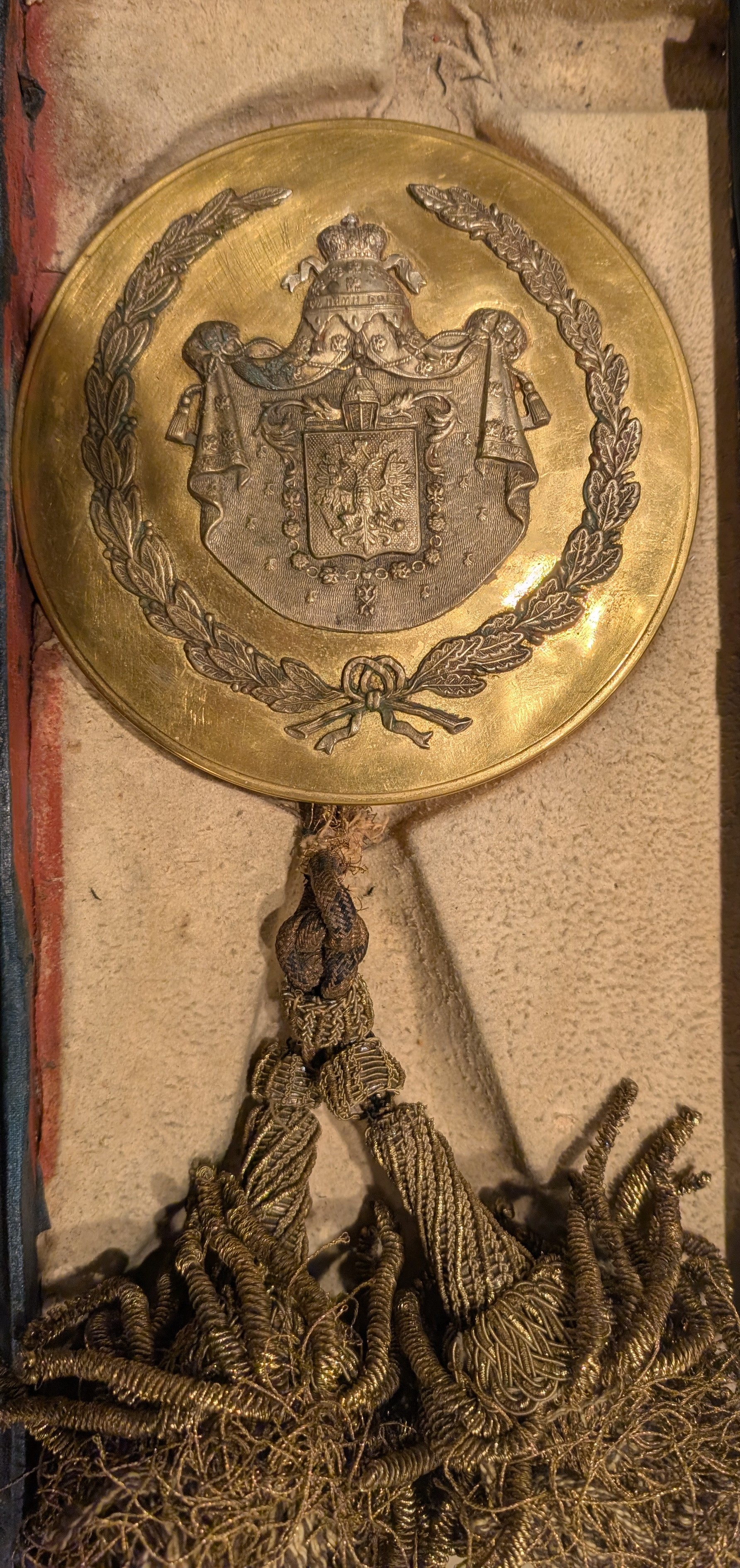
The objects accompanying the manuscript extend that display of authority. The photograph below shows the decorated lid of the seal canister, rather than the wax impression protected inside it. A crowned imperial eagle appears within a heraldic mantle, encircled by a wreath. Cords and tassels connect the canister to the document. The illuminated page and the protected seal give the written grant a durable material form.
The honor also exposes a tension in Jewish life under imperial rule. Alexander III’s reign brought intensified restrictions on Jews. Recognition of an individual Jewish physician could coexist with discrimination against Jews as a population. Rosenthal’s distinction therefore offers evidence of a path to exceptional standing through professional service, while reminding us how far such recognition remained from equal rights.
The charter’s ceremonial Russian lettering, written by hand, recalls the formal book hands of medieval Slavic manuscripts, and brings Jewish medical history into view through an object of state authority. The physician’s long service finds acknowledgment in the same imperial forms used to establish and preserve social hierarchy. Its elaborate decoration makes that relationship visible: one man’s distinction appears within the encompassing symbols of the empire.