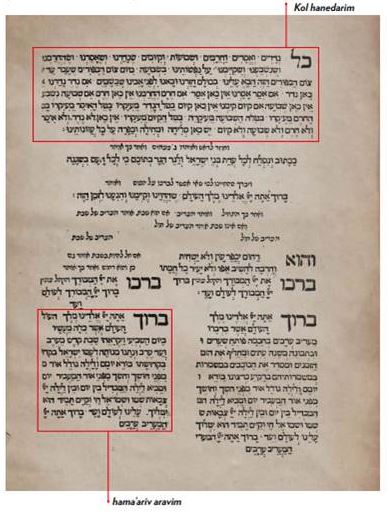
This maḥzor—literally, a “cycle,” the Hebrew name for a festival prayer book—was printed in the northern Italian towns of Soncino and Casalmaggiore between September 1485 and August 1486. It belongs to the earliest generation of European printed books, known as incunables, from the Latin word for “cradle,” because they represent printing in its infancy. Hebrew incunables are exceptionally rare: fewer than two hundred Hebrew editions are known to have been printed before 1501.
The printers were members of the famous Soncino family, pioneers of Hebrew printing. Although the Soncinos themselves were of Ashkenazic origin, they printed books for different Jewish communities. Printing was a business as well as a religious and cultural enterprise. This maḥzor follows the Roman rite, the ancient liturgical tradition of the Jews of Italy, whose customs differed in important ways from both Ashkenazic and Sephardic prayer traditions.
The page shown here preserves two striking examples. At the top appears Kol ha-Nedarim (“All the Vows”), the declaration recited before Yom Kippur. Most Jews know this declaration by its Aramaic opening words, Kol Nidrei (“All Vows”), while the Italian tradition preserved a distinctive Hebrew form. At the lower left appears another unusual survival: a special Sabbath version of the evening blessing praising God as the One “who brings on the evening.” Rather than the familiar weekday wording, it begins, “Who completed His work on the seventh day.” A form of this blessing is already known from the prayer book of the tenth-century Babylonian Jewish scholar Rav Saadiah Gaon.
These differences may appear small, but they preserve the history of an entire community. The Jews who followed the Roman rite constituted a distinctive minority within the larger Jewish world, maintaining prayers and customs that could easily have disappeared as other rites became more widespread.
The printing press is often associated with standardization: once a text could be reproduced hundreds of times, one version might be expected to displace its competitors. This maḥzor demonstrates another possibility. Early Hebrew printers could use the new technology to reproduce and preserve precisely the local traditions that distinguished one Jewish community from another. The Soncinos, Ashkenazic printers working in Italy, helped ensure that the distinctive voice of Italian Jewry would survive on the printed page.