

Rothschild Mahzor 6v
Rothschild Mahzor 6v
The Rothschild Mahzor is a Jewish prayer book for the Roman rite, handwritten and illuminated in Florence in 1490. The scribe, Abraham Judah ben Yehiel of Camerino, copied the text in Italian semi-cursive script. Its decoration, featuring floral designs, gold leaf, and colorful initials, reflects the artistry of multiple Florentine workshops (ateliers). Manuscript production in Renaissance Florence often involved collaborations among scribes, illuminators, and goldsmiths, blending Jewish liturgical needs with local artistic traditions.
Rich Jewish families of the Italian Renaissance often imitated their high-status Christian neighbors, commissioning luxury books on fine parchment for their private collections. This was a way of showing their wealth and nobility. Like their Christian neighbors, they also often created symbolic stemmi (lit. “garlands” or “wreaths”) to visually represent their families. With the stemma on this page (center bottom) the Gallico family intended to show their riches and status by imitating the hereditary insignias of the rich and noble Christian families of the region. Gallico family arms usually included a rooster as a visual pun on the family name (gallo is rooster in Italian).
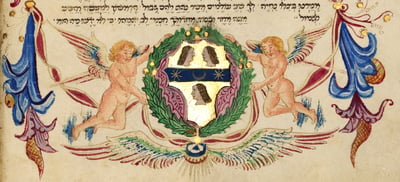
Outstanding on this page, as on others, are the little naked child-angels, called “putti.” The putti here, as elsewhere, have a dynamic appearance, as though they are moving. Do these images strike you as out of place in a Jewish manuscript? They are actually quite common. Angels were an important part of Jewish tradition, and the second commandment’s prohibition upon such images was observed mostly in the breach.
The lack of Jewish symbols makes it very likely that the workshop behind this page was not a Jewish studio. Elijah Gallico hired them, probably because of their fine reputation, sophistication, and skill.


